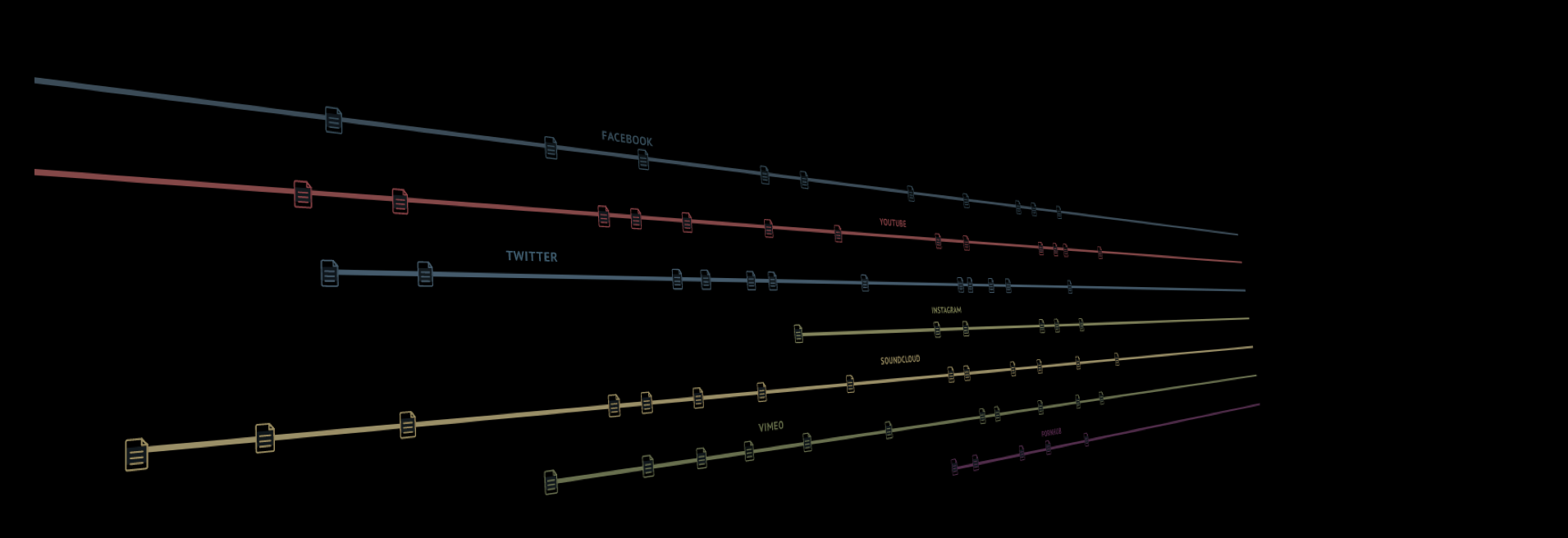
The Platform Governance Archive (PGA) is a data repository and platform that collects and curates policies of major social media platforms in a long-term perspective. When have YouTube and Instagram introduced hate speech policies? How have misinformation policies changed over time? With the help of the archive, researchers, journalists and the public can answer their questions on how platforms order and govern communication and interaction in our societies, and hold those powerful new institutions accountable.
Data
Explore and download the PGA datasets.
Explore
Explore the historical dataset in an interactive visualisation with timelines of changes.
Research
Explore existing research on platform policies based on PGA data and beyond.
The PGA is hosted by Lab Platform Governance, Media, and Technology at the Centre for Media, Communication and Information Research (ZeMKI), University of Bremen and led by Christian Katzenbach. We collaborate with the Alexander von Humboldt Institute for Internet and Society (HIIG), the University of Groningen, and Open Terms Archive for the curation and collection of the policies.
» About PGA
-
YouTube Expands the Scope of Legal Disclosure Obligations
With effect from 11 December 2025, YouTube updated its Privacy Policy (Line 425). The updated policy now clarifies that, in addition to court orders and government requests, certain statutes also compel Google to share user data with regulators, accredited researchers, and authorised out‑of‑court dispute bodies. Added: Certain laws require us to share information with regulators…
-
Twitch Relativised Minimum-Age Requirement for Accessing Their Services
Effective on 09 December 2025, Twitch updated their terms of service to revise their age policy. Instead of a universal “at least 13 years old” rule, the platform now requires users to meet the minimum age mandated by their local jurisdiction. This change was made as a clear response to Australia’s social‑media ban for children under 16 years old…
-
Facebook Has Streamlined its Community Guidelines Regarding the Inauthentic Behaviour
On 12 December 2025, Facebook updated its policy on inauthentic behaviour. Rather than using explicit language to prohibit specific cases, particularly those related to politics and elections, the policy now adopts a more content-agnostic framing. Subcategories of prohibited actions (e.g. distribution, audience building, foreign inauthentic behaviour, and engagement) have been removed and consolidated under a…